Each year, HCFANY submits comments to the Department of Financial Services (the Department) as part of the State’s rate review process. The annual rate review process allows the Department to regulate health insurance premiums for the ACA marketplace. HCFANY’s comments focus on carriers offering products on New York’s individual market and cover the rate applications of all 12 carriers (health insurance companies) with on-exchange products. These letters submitted by HCFANY are linked below, by carrier.
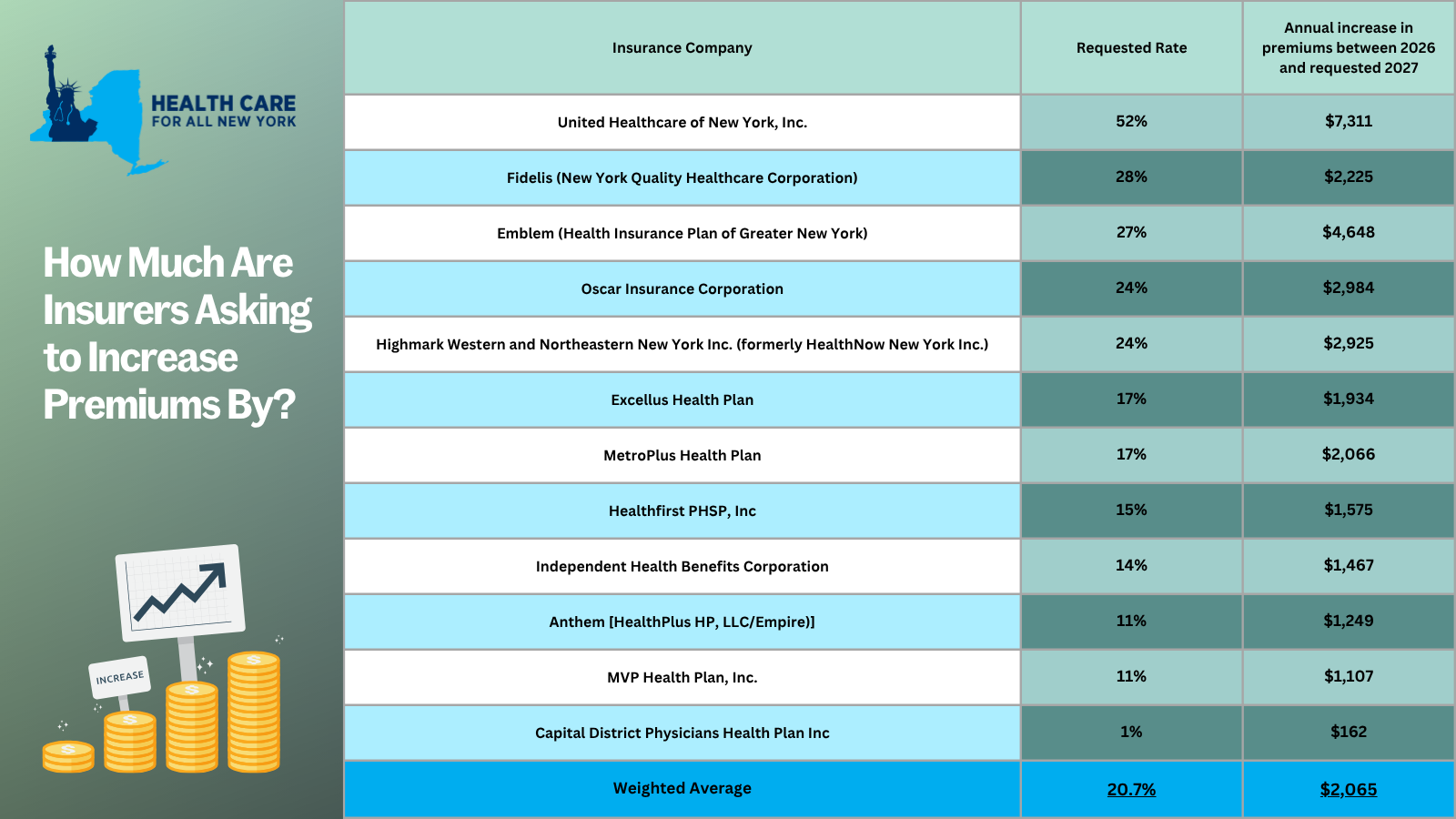
New York’s individual market carriers are seeking a weighted average premium increase of 20.7 percent, which is over five times the rate of inflation. If this year’s requests are approved, it will result in an average premium increase of 64 percent over the last five years, with four carriers’ premiums doubling in this period. In other words, if rates are approved, there will be an average premium increase of $390 per month, over the last five years.
Consumers with job-based coverage have employers, brokers, and agents who can negotiate the best premiums, scope, and coverage for their employees. By contrast, consumers in the individual market have no bargaining power over affordable premiums and out-of-pocket costs. This population depends on the Department to safeguard health insurance affordability through the annual process of rate review.
Market changes
Rate requests for the 2027 plan year coincide with two counteracting changes in the individual market:
- Expiration of enhanced advanced premium tax credits (eAPTCs)
The American Rescue Plan expired at the end of 2025, and the federal government did not extend the eAPTCs. As a result, many individuals lost federal financial assistance with health insurance premiums and exited the market. Since last year, around 46,600 enrollees have left the market.
- Return of the Essential Plan 200-250 FPL population
As a result of the State’s return to the Basic Health Program, 444,000 individuals who were previously covered through the Essential Plan lost eligibility on July 1, 2026. A portion of this population is expected to return to the individual market, likely counterbalancing the number leaving the market due to the expiration of eAPTCs.
Medical inflation (claim trend)
The annual claim trend is the portion of the rate request based on changes in prices and utilization of medical and pharmaceutical care. New York’s carriers submitted inconsistent annual claim trend estimates, indicating that many have not effectively controlled health care costs. The carriers’ estimates for the 2027 plan year range from 8.9 percent to 14.7 percent, with a weighted-average trend rate of 11.5 percent. This trend appears inflated and is a significant jump from the 6.7 percent approved trend over the past five years.
Additionally, this trend does not align with publicly available national estimates of claim trend. See Figure 9.
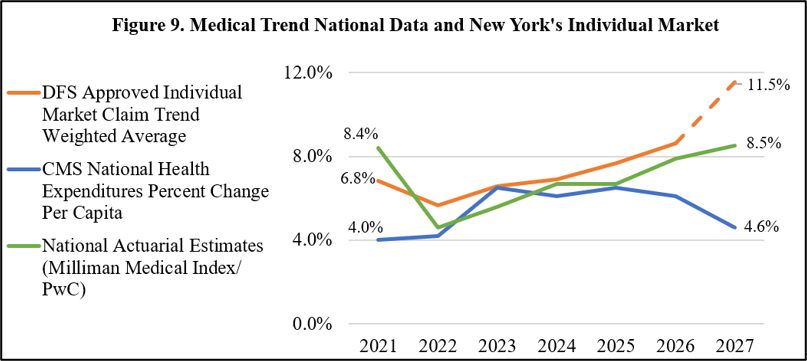
To protect patients in the 2027 plan year, HCFANY kindly asks the Department to cap each carrier’s claim trend at its respective five-year approved average. See hyperlinked letters below for more detail.
Medical expenses (Medical Loss Ratio)
Generally, premium dollars paid to carriers go toward three things: payment of medical expenses incurred by patients, administrative costs, and profit/surplus.
In New York, a minimum of 82 percent of premium dollars paid to a carrier must be used to cover payment of medical expenses (claims). This metric is referred to as a carrier’s medical loss ratio (MLR).
- An MLR exceeding 100 percent indicates that the carrier incurred more claims than could be paid by the amount they received in patient premiums.
- An MLR under 82 percent is against the law and indicates that a carrier easily covered its incurred claims and thus overcharged patients.
The MLR of five carriers in the state (MetroPlus, Emblem, Fidelis, Oscar, IHBC) fell below 82 percent in 2025. HCFANY urges the department to consider historical MLR data when approving carrier’s rate requests, and exercise caution when determining 2027 rates.
Administrative expenses
For the 2027 plan year, the carriers seek to spend, on average, 12 percent of premium dollars on administrative expenses.
HCFANY lauds the Department for capping administrative costs and preventing them from creeping up over the past six years, despite the carriers’ excessively high requests. To continue this practice, HCFANY encourages the Department to consider setting an expense ratio ceiling at or below 10 percent, in recognition of the State’s health care affordability crisis.
Profits
For the 2027 plan year, the carriers seek to retain an average of 2.1 percent of premium dollars for profit. This request is higher than the average approved profits for past years, which were around or below 1 percent.
However, reported actual profits of individual market carriers have trended upward since 2022, with the market-wide average in 2025 reaching 3.6 percent. Though driven by a few carriers (Anthem, Healthfirst, MetroPlus, MVP, Oscar), this figure is still much too high. In its 2027 comments, HCFANY kindly urges the Department to return to its practice of capping profits at 0.5 percent.
Patient voices
An integral part of the rate review process is the submission of personal comments from consumers. HCFANY thanks the Department for publishing these, exhibiting the direct impact rate increases have on patient livelihoods:
- “We are grateful this plan is available on the market, as without it we would have nothing, but currently the plan costs more than our rent. … Health insurance is not a luxury for us or anyone—last year, health insurance and the subsequent access to care meant the difference between life and death for me—but it is beginning to be priced like one.”
- “I am self-employed and pay 100% of my family’s health insurance premiums and copays out of pocket… An 11.3% increase would add more than $350 to that bill every single month, bringing our annual health insurance cost to well over $41,000. That is not a rounding error. That is a car payment. That is groceries. That is my 10-year-old son’s future.”
- “I am not someone who can simply choose to go without health insurance. I am a cancer survivor who requires ongoing medical surveillance, and my daughter also relies on this coverage. We are exactly the type of household that depends on a stable and functioning individual insurance market.”
In addition to comments about the individual market at large, HCFANY details why the Department should curb specific elements of each carrier’s request. These letters aim to protect patients from further increases in already unaffordable health care costs, and can be found below:
- Anthem
- CDPHP
- Emblem
- Excellus
- Fidelis
- Healthfirst
- Highmark
- Independent Health
- MetroPlus
- MVP
- Oscar
- United
With the release of New York’s FY2026-2027 Final Budget, HCFANY thanks the Governor and the Legislature for enacting proposals to help consumers and patients access affordable, quality health care, and hopes to see continued efforts as HR1 policies are implemented over the next several years. HCFANY is disappointed that the final budget fails to protect Essential Plan coverage for half a million New Yorkers who will lose it this July.
HCFANY’s response to this year’s budget falls under four categories: (I) Mitigating Losses from Federal Cuts to Health Care, (II) Protecting and Improving Health Coverage, (III) Enhancing Consumer Transparency, and (IV) Regulating Health Care Prices.
(I) Mitigating Losses from Federal Cuts to Health Care
On July 4, 2025, President Donald Trump signed HR1, also known as the “One Big Beautiful Bill Act”, which has drastically altered eligibility and funding for health insurance for New Yorkers. The New York Department of Health (NYSDOH) estimates that 1.5 million New Yorkers, citizens and immigrants alike, will become uninsured as the changes under HR1 are implemented over the next couple of years.
Action to preserve Essential Plan (EP) coverage for 1.3 million New Yorkers.
Last September, Governor Hochul requested to terminate the State’s Section 1332 Waiver, which would return the EP to the Basic Health Plan under Section 1331 of the Affordable Care Act. This March, New York State of Health announced that the Centers for Medicare and Medicaid Services (CMS) approved New York’s request and will complete this transition on July 1, 2026.
HCFANY is disappointed the final budget did not include funding to keep half a million New Yorkers covered.
In the State’s transition back to the Basic Health Plan, half a million New Yorkers will lose access to health insurance this July, including individuals on the Essential Plan with incomes between 200 to 250 percent of the Federal Poverty Level (FPL), with DACA and PRUCOL statuses, and lawfully present immigrants losing eligibility for premium tax credits. HCFANY fought hard to garner support from the Legislature to sign on to S9589/A10926, a proposal which would preserve coverage for this population, with significant help from the bill sponsors—Senator Rivera and Assemblymember Paulin. Amid devastating federal health care cuts, HCFANY hopes to see the State take action to provide coverage for the half a million New Yorkers losing health coverage starting this July in next year’s Budget.
Action to terminate continuous coverage for children ages 0-6 years
The federal government has made it clear that the State will be forced to discontinue its continuous coverage program for children up to age six, made possible through New York’s Medicaid 1115 Waiver. Although this waiver ends in March 2027, the final budget repeals this program this July.
(II) Protecting and Improving Health Coverage
Expanding continuity of care protections.
Continuity of care protects patients through network disruptions when (1) their provider leaves the plan’s network or (2) the patient switches plans and the current provider they see is no longer in network. The final budget made the following changes to these scenarios:
(Scenario 1: When their provider leaves your plan’s network) A patient is eligible to continue seeing their current provider at the same in-network costs for up to 90 days, or if applicable, through the end of the patient’s postpartum care.
(Scenario 2: When a patient switches health plans and their current provider is no longer in network) A patient is eligible to keep in-network costs with their current provider if the patient has a life-threatening condition, for up to 60 days, and starting January 1, 2027, up to 90 days, only if the provider agrees to the payment rate and rules of the new plan. If pregnant, the patient will be able to see their current provider through the end of postpartum care.
Protecting consumers from repetitive and redundant health plan utilization reviews for individuals with chronic conditions.
A utilization review is conducted to determine if a treatment, testing, or procedure is medically necessary for a patient. The final budget bans this review from being conducted more than once per year, unless the provider changes the patient’s course of treatment.
(III) Enhancing Consumer Transparency
The final budget implements many requirements for insurers who provide coverage on the New York State of Health Marketplace (NYSOH) to improve consumer transparency, many of which complement the recently released 2027 Plan Invitation.
Improving the Department of Financial Services (DFS) Consumer Guide.
The DFS Consumer Guide, which helps consumers pick health plans on NYSOH, will now provide information on grievances, approvals, adverse determinations, appeals, and other pre-authorization issues filed for each plan. HCFANY hopes the State continues to improve the Consumer Guide to serve more consumers, for example, by including DOH-regulated plans. Currently, the Guide does not report on plans that cover 80% of New Yorkers in the individual market.
Requiring public notice when contracts between hospitals and health plans end.
In the final budget, public notice is now required when contracts between hospitals and health plans are planned to end. This will help consumers stay informed when network disruptions occur.
Requiring health plans to make their formulary drug lists more accessible.
Health plans in New York are required to disclose to patients which prescription drugs are covered under their plan in a formulary drug list. Consumers will now be able to view this list without creating an account or password and will have an easier time determining which plan it applies to, if an insurer offers multiple plans.
Adding more covered services, including vision, dental, and nearby cancer centers, to the Essential Plan benefit package.
Next, the final budget will expand coverage of services in the Essential Health Plan Benefit package, including vision and dental care and services provided by cancer centers licensed by DOH within a nearby service area.
(IV) Regulating Health Care Prices
Weakened government oversight on health care transactions
Initially proposed in the Executive Budget, the final budget omitted the proposal requiring the DOH to conduct a more intensive review of health care transactions for cost, quality, access, health equity, and competition, and implementing additional requirements for written notices of such transactions.
Medicaid beneficiaries are now excluded from the independent dispute resolution (IDR) process.
The IDR process was implemented to protect consumers from surprise medical bills by establishing a third-party entity that reviews the payment offers from both the insurer and the provider to determine the cost of the out-of-network service.
Over 6.6 million New Yorkers browse and enroll in health coverage through New York’s official health plan Marketplace, New York State of Health (NYSOH). As of January 2026, 4.1 million were enrolled in Medicaid, 210,000 in Qualified Health Plans, 551,000 in Child Health Plus, and 1.7 million in the Essential Plan. Every year, the New York Department of Health (DOH) issues a plan invitation that outlines requirements and guidelines that health insurers must follow to participate in the Marketplace. HCFANY is thankful for the continued efforts of the State to ensure that consumers have an easier time navigating, affording, and accessing health insurance coverage in New York, amid federal cuts to health care.
New Yorkers who receive coverage through NYSOH have been greatly impacted by federal health care cuts, enacted by HR1. Those previously on Qualified Health Plans have already lost enhanced premium tax credits, which expired last year. With the termination of New York’s Section 1332 Waiver, cost-sharing initiatives that helped around 62,000 individuals save $50 million in health care costs will end. Lastly, half a million will lose their Essential Plan coverage starting July, unless the State acts now and implements bill S9589|A10926 in the final budget.
From this year’s 2027 NY State of Health Plan Invitation, HCFANY is pleased to see the following recommendations adopted:
Enforcing greater network adequacy standards:
- Specialists, or non-primary care providers, must meet the 30-minute or 30-mile time-and-distance standards.
Improving consumer transparency through network disruptions and provider directories:
- Plans are now required to submit disruption analysis reports earlier to NYSOH, at least 30 days before any consumer notices are scheduled to go out.
- Plans need to provide hospital network contracting status and anticipated contract end dates on a bi-annual basis for NYSOH to proactively monitor network stability for consumers.
- Plans must indicate and give consumers advance notice within their online provider directories when a provider, group, or facility will be leaving the network.
- The Department of Health will start collecting data and metrics on consumer complaints with provider directories.
Protecting consumers during substantial network changes:
- A special enrollment period will be created for members who experience a mid-year network disruption that materially affects access to covered services to allow consumers to change plans.
Expanding the Consumer Guide:
- NYSOH will collaborate with Department of Financial Services (DFS) to improve the consumer guide for individual market consumers by including DOH-regulated plans.
Enhancing information access to mental health and substance use disorder services:
- Plans must now establish and maintain a publicly accessible webpage that provides enrollees with information about behavioral health resources.
HCFANY is grateful that DOH and DFS continue to prioritize consumer protection and transparency. Stay tuned, as HCFANY will review the final State budget in the coming weeks.
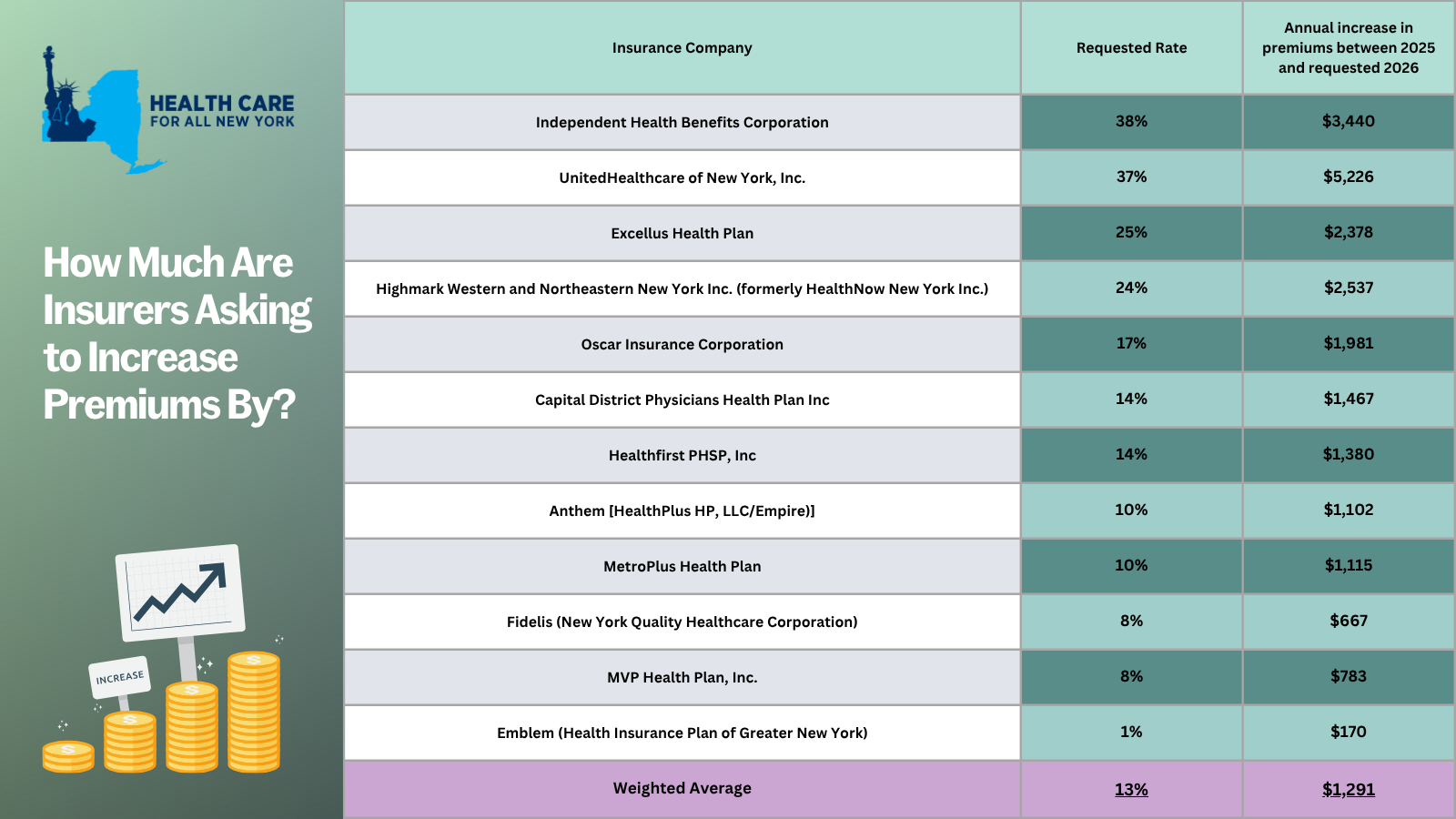
New York’s individual market premiums might increase by up to 13 percent in 2026, forcing consumers to pay an extra $1,291 more annually. New York’s twelve individual market carriers are requesting increases ranging from one percent by Emblem to a staggering 38 percent by Independent Health. These requests far surpass requests from carriers in other states.
In our comments, HCFANY breaks down why DFS should curb each carrier’s specific rate requests to protect patients from another unaffordable increase in health care costs. Find your carrier in the list below:
- Anthem
- CDPHP
- Emblem
- Excellus
- Fidelis
- Healthfirst
- Highmark
- Independent Health
- MetroPlus
- MVP
- Oscar
- United