
Background
In New York, health care costs are rising twice as fast as inflation and hospital costs are a major contributor to the State’s high health care spending. This rapid increase in health care costs led New York to have the second-highest health insurance premiums in the nation in 2023. Patients have found themselves increasingly unable to afford care, especially those who are uninsured or underinsured, causing them to incur medical debt. A 2025 survey showed that 66 percent of New Yorkers delayed or went without care in the past year due to costs, and 80 percent are worried about affording care in the future. Medical debt affects multiple aspects of a patient’s life, from worse mental and physical health to extreme financial hardships.
Despite New York having only non-profit or public hospitals, some providers utilized aggressive medical debt collection tactics, including filing lawsuits against patients who should have qualified for financial assistance. Under the State’s Hospital Financial Assistance Law, New York hospitals must offer financial assistance for eligible patients on a sliding-fee scale based on the patient’s household income. Yet some hospitals made it extremely difficult for patients to apply by illegally requiring additional documentation, such as pay stubs, tax returns, or social security numbers. To tackle this issue, the Community Service Society of New York (CSS) launched the #EndMedicalDebt campaign in 2019.
Our Work
CSS addressed the medical debt crisis with a three-prong strategy: research and publications, outreach to hospitals, and grassroots organizing through the We The Patients and #EndMedicalDebt campaigns.
Research and Publication
Starting with the Discharged into Debt report series, CSS extensively documented hospital collection practices in New York, from pandemic-era lawsuits and racial disparities in Albany to liens placed on patients’ homes and wage garnishments. CSS identified more than 80,000 medical debt lawsuits filed by hospitals in the past decade, with many targeting low-income patients or people of color. Most of these lawsuits resulted in default judgments, meaning patients never appeared in court to defend themselves. These findings were also supported by the Urban Institute’s research, which showed a correlation between lawsuit hotspots and high rates of medical debt on credit reports. As a result, research served as a foundation for the campaign’s evidence-based case for reform.
Outreach to Hospitals
CSS advocates reached out to several hospitals and health systems that filed the most lawsuits or had noteworthy medical debt collection tactics and financial assistance policies. In response, many hospitals stopped or substantially reduced these practices, withdrew cases, and reformed their financial assistance policies.
Grassroot Organizing Through We The Patients and #EndMedicalDebt Campaigns
The #EndMedicalDebt campaign connected over 50 organizations representing different constituencies across New York. It turned the lived experiences of New Yorkers with medical debt into a call for Legislative action by hosting town halls with elected officials, sharing patient testimonies, educating the public, and circulating petitions. Similarly, the We The Patients campaign elevated patient concerns and stories to New York lawmakers through forums, online engagement, and social media. Both campaigns leveraged the voices of everyday New Yorkers to secure the passage of medical debt protections through the State budget and Legislative session.
Policy Wins
During this campaign, several medical debt reform laws were enacted. New York:
- Shortened the statute of limitations, the timeframe hospitals have to sue patients for medical bills.
- Lowered the interest rate on consumer judgments to reduce the financial burden for patients with medical debt rulings.
- Banned hospitals from putting liens on patients’ homes or taking money from their wages to collect medical debt.
- Prohibited facility fees for preventive care and required providers to inform patients about them beforehand.
- Required transparency from hospitals about their prices and quality of care, which can help policymakers hold hospitals accountable for rising costs.
- Mandated all hospitals to use the same financial assistance application to reduce the barriers patients face when applying.
- Barred Hospitals from reporting medical debt to credit bureaus and removed medical debt from consumer credit reports.
- Expanded eligibility for hospital financial assistance and banned hospitals from suing patients under 400% of the Federal Poverty Level. See all reforms to hospital financial assistance here.
- Removed cost-sharing for insulin and inhalers for New Yorkers with State-regulated plans, making New York the first state to do so.
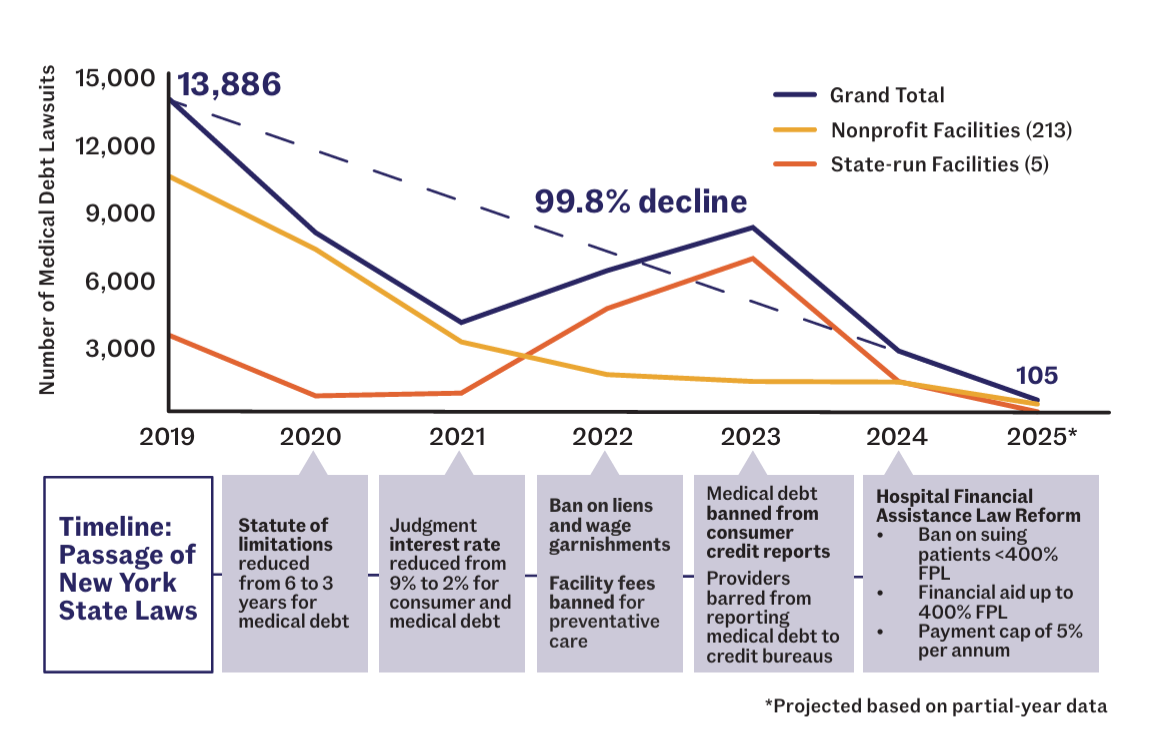
As a result of these reforms, medical debt lawsuits from New York hospitals declined by 99.8 percent, from 13,886 annually to 105, saving patients an estimated $36 million per year. The proportion of New Yorkers with medical debt in collections also fell from 7.6 percent in 2018 to nothing in 2026, following the removal of an estimated $241 to $337 million in medical debt from consumer credit reports. The success of the #EndMedicalDebt campaign has improved the lives of New Yorkers and created a model that can be replicated in other states or at a federal level.
The Fight is Not Over
The collective efforts have resulted in meaningful progress, but the fight is not over. With millions of people at risk of losing health care coverage due to federal cuts in HR 1 or the “One Big Beautiful Bill”, the campaign will continue to protect patients.