
The New York Department of Financial Services (the Department) reduced individual market carriers’ requested rate increases by 71 percent for plan year 2027. Carriers initially requested a 21 percent average rate increase—the highest of the past seven years—but through New York’s prior approval process, the Department cut this hike to an average of six percent. Of the approved rates, four carriers were not permitted to raise premiums (received an approved rate of zero percent), while one carrier’s approved rate was a premium decrease of three percent.
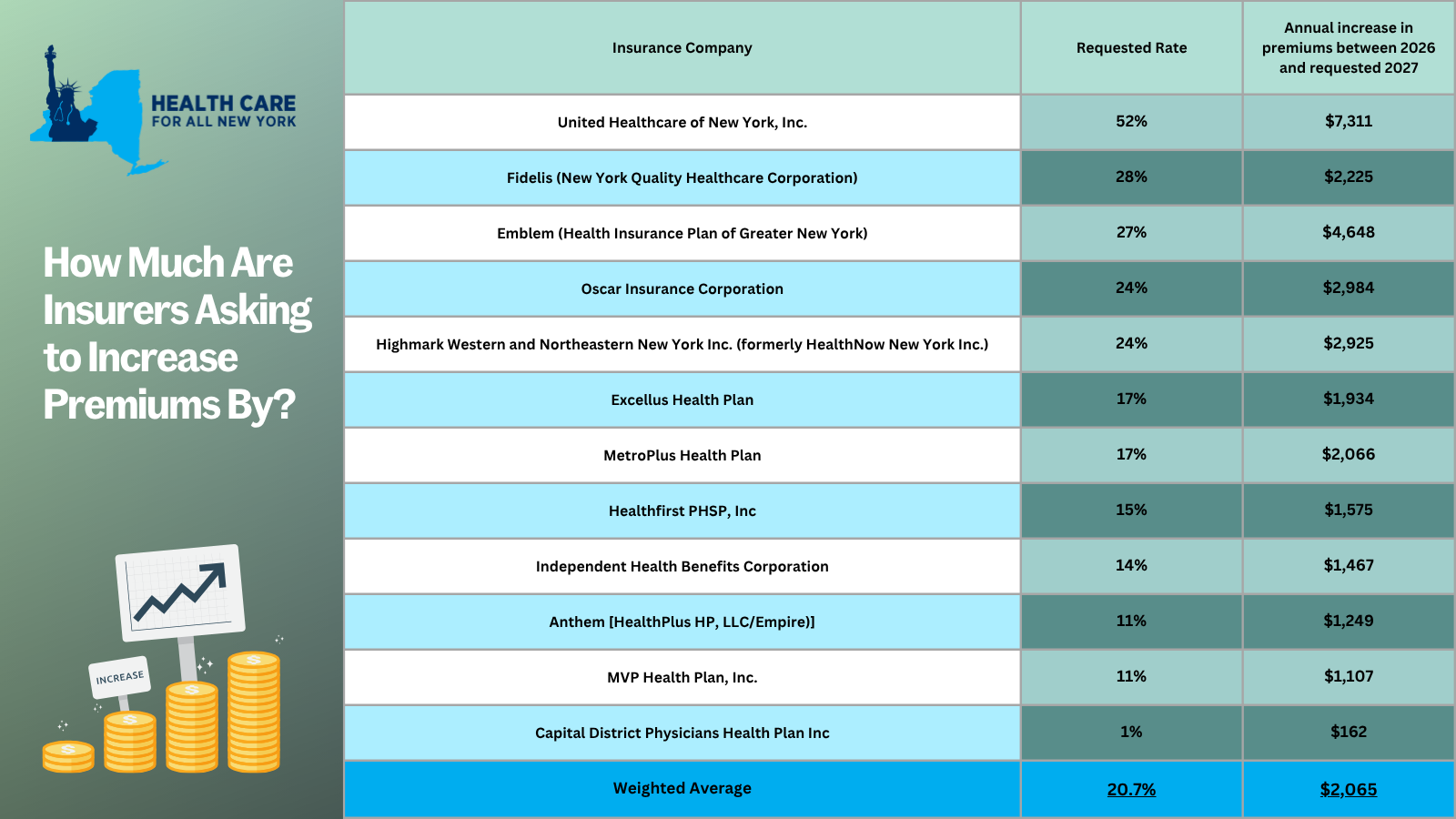
Without this process, rates requested by insurance carriers would have required New Yorkers to pay an average of $2,065 more annually, or $172 more per month, in premiums next year. With the newly approved rates from the Department, the annual increase in premiums is now $600, or $50 per month, for next year.
The table below compares health plans’ initial rate requests with rates that were ultimately approved, providing insight into how this process impacts health care costs (HCFANY’s detailed comments on each carrier’s rate request can also be reviewed here).

The prior approval process serves as an essential safeguard to curb rising health care costs. In 2024 and 2025, the State approved steep premium increases of 12 percent and 13 percent, respectively. Approved rates were comparatively lower for 2026, with an average of 7 percent. The approved rate of 6 percent for the 2027 plan year marks the lowest average approved rate since 2022.
HCFANY commends the Department for substantially decreasing this year’s rates, particularly in its decisions for CDPHP, Emblem (HIP), Anthem, IHBC, and MetroPlus. However, with the recent expiration of federal subsidies and influx of consumers to the individual market due to State’s transition back to the Basic Health Plan, New York should consider additional strategies to improve affordability.
To do so, the State can implement many proposals in HCFANY’s Policy Agenda that will help patients get affordable care and coverage, like the H.R. 1 Coverage Loss Mitigation Policy Package, the Primary Care Investment Act, and the Fair Pricing Act.
Many New Yorkers, who purchase their own health coverage through the New York State of Health marketplace, are eligible for subsidies. If you need help switching plans or finding affordable health insurance, the Navigators program offers free, unbiased guidance and can help you understand your premium assistance and coverage options. You can contact Navigators through the CSS Navigator Network at 888-614-5400 or email enroll@cssny.org.
Each year, HCFANY submits comments to the Department of Financial Services (the Department) as part of the State’s rate review process. The annual rate review process allows the Department to regulate health insurance premiums for the ACA marketplace. HCFANY’s comments focus on carriers offering products on New York’s individual market and cover the rate applications of all 12 carriers (health insurance companies) with on-exchange products. These letters submitted by HCFANY are linked below, by carrier.
New York’s individual market carriers are seeking a weighted average premium increase of 20.7 percent, which is over five times the rate of inflation. If this year’s requests are approved, it will result in an average premium increase of 64 percent over the last five years, with four carriers’ premiums doubling in this period. In other words, if rates are approved, there will be an average premium increase of $390 per month, over the last five years.
Consumers with job-based coverage have employers, brokers, and agents who can negotiate the best premiums, scope, and coverage for their employees. By contrast, consumers in the individual market have no bargaining power over affordable premiums and out-of-pocket costs. This population depends on the Department to safeguard health insurance affordability through the annual process of rate review.
Market changes
Rate requests for the 2027 plan year coincide with two counteracting changes in the individual market:
- Expiration of enhanced advanced premium tax credits (eAPTCs)
The American Rescue Plan expired at the end of 2025, and the federal government did not extend the eAPTCs. As a result, many individuals lost federal financial assistance with health insurance premiums and exited the market. Since last year, around 46,600 enrollees have left the market.
- Return of the Essential Plan 200-250 FPL population
As a result of the State’s return to the Basic Health Program, 444,000 individuals who were previously covered through the Essential Plan lost eligibility on July 1, 2026. A portion of this population is expected to return to the individual market, likely counterbalancing the number leaving the market due to the expiration of eAPTCs.
Medical inflation (claim trend)
The annual claim trend is the portion of the rate request based on changes in prices and utilization of medical and pharmaceutical care. New York’s carriers submitted inconsistent annual claim trend estimates, indicating that many have not effectively controlled health care costs. The carriers’ estimates for the 2027 plan year range from 8.9 percent to 14.7 percent, with a weighted-average trend rate of 11.5 percent. This trend appears inflated and is a significant jump from the 6.7 percent approved trend over the past five years.
Additionally, this trend does not align with publicly available national estimates of claim trend. See Figure 9.
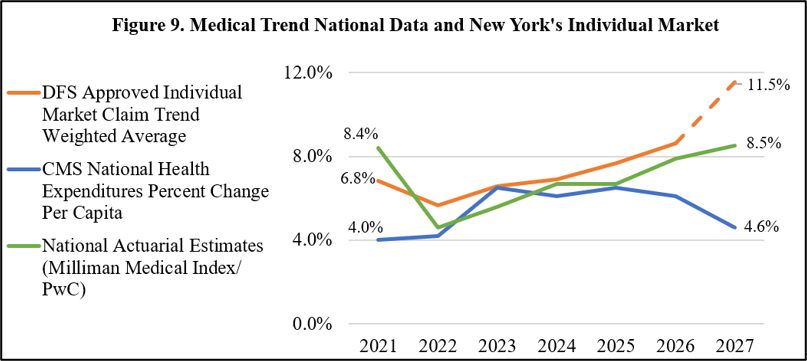
To protect patients in the 2027 plan year, HCFANY kindly asks the Department to cap each carrier’s claim trend at its respective five-year approved average. See hyperlinked letters below for more detail.
Medical expenses (Medical Loss Ratio)
Generally, premium dollars paid to carriers go toward three things: payment of medical expenses incurred by patients, administrative costs, and profit/surplus.
In New York, a minimum of 82 percent of premium dollars paid to a carrier must be used to cover payment of medical expenses (claims). This metric is referred to as a carrier’s medical loss ratio (MLR).
- An MLR exceeding 100 percent indicates that the carrier incurred more claims than could be paid by the amount they received in patient premiums.
- An MLR under 82 percent is against the law and indicates that a carrier easily covered its incurred claims and thus overcharged patients.
The MLR of five carriers in the state (MetroPlus, Emblem, Fidelis, Oscar, IHBC) fell below 82 percent in 2025. HCFANY urges the department to consider historical MLR data when approving carrier’s rate requests, and exercise caution when determining 2027 rates.
Administrative expenses
For the 2027 plan year, the carriers seek to spend, on average, 12 percent of premium dollars on administrative expenses.
HCFANY lauds the Department for capping administrative costs and preventing them from creeping up over the past six years, despite the carriers’ excessively high requests. To continue this practice, HCFANY encourages the Department to consider setting an expense ratio ceiling at or below 10 percent, in recognition of the State’s health care affordability crisis.
Profits
For the 2027 plan year, the carriers seek to retain an average of 2.1 percent of premium dollars for profit. This request is higher than the average approved profits for past years, which were around or below 1 percent.
However, reported actual profits of individual market carriers have trended upward since 2022, with the market-wide average in 2025 reaching 3.6 percent. Though driven by a few carriers (Anthem, Healthfirst, MetroPlus, MVP, Oscar), this figure is still much too high. In its 2027 comments, HCFANY kindly urges the Department to return to its practice of capping profits at 0.5 percent.
Patient voices
An integral part of the rate review process is the submission of personal comments from consumers. HCFANY thanks the Department for publishing these, exhibiting the direct impact rate increases have on patient livelihoods:
- “We are grateful this plan is available on the market, as without it we would have nothing, but currently the plan costs more than our rent. … Health insurance is not a luxury for us or anyone—last year, health insurance and the subsequent access to care meant the difference between life and death for me—but it is beginning to be priced like one.”
- “I am self-employed and pay 100% of my family’s health insurance premiums and copays out of pocket… An 11.3% increase would add more than $350 to that bill every single month, bringing our annual health insurance cost to well over $41,000. That is not a rounding error. That is a car payment. That is groceries. That is my 10-year-old son’s future.”
- “I am not someone who can simply choose to go without health insurance. I am a cancer survivor who requires ongoing medical surveillance, and my daughter also relies on this coverage. We are exactly the type of household that depends on a stable and functioning individual insurance market.”
In addition to comments about the individual market at large, HCFANY details why the Department should curb specific elements of each carrier’s request. These letters aim to protect patients from further increases in already unaffordable health care costs, and can be found below:
- Anthem
- CDPHP
- Emblem
- Excellus
- Fidelis
- Healthfirst
- Highmark
- Independent Health
- MetroPlus
- MVP
- Oscar
- United
Legislative Voices
On August 21, 2026, Senator Gustavo Rivera and Assembly Member Jessica González-Rojas, along with 70 Elected Officials, sent this letter to the Acting Superintendent of the Department of Financial Services, urging DFS to reject excessive health insurance premium increases for the 2027 Plan Year.
HCFANY is thankful to have the opportunity to testify at the 2026 Joint Legislative Budget Hearing on Health. Find HCFANY’s detailed Executive FY27 Testimony here. The Executive Budget includes many proposals to help protect and enhance New Yorkers’ access to affordable health coverage.
HCFANY’s budget testimony covers three topics:
- Protect and improve health coverage
- Regulate prices to create a more affordable health care system for New Yorkers
- Robustly fund consumer assistance and enrollment programs and increase Article 6 funding to help New Yorkers navigate new complex hurdles
(I) Protect and Improve Health Coverage
The enactment of HR 1 will drastically alter eligibility and funding for health insurance, leaving an estimated 1.5 million New Yorkers at risk of losing their coverage. Coverage losses for individuals on the Essential Plan may go into effect as soon as July 2026, so it is imperative that the State have a plan in place to mitigate these federal cuts.
- Support the transition from 1332 Waiver to 1331 Basic Health Plan (BHP) to allow 609,000 lawfully present immigrants to stay covered.
If the federal government approves this change, 444,000 people enrolled in New York’s Essential Plan with incomes between 200-250 percent of the Federal Poverty Level (FPL) will become newly ineligible for the Essential Plan mid-year. The State should provide coverage options and financial support for this population: 6,000 individuals with Deferred Action for Childhood Arrival (DACA) immigration status or who are Permanently Residing Under Color of Law (PRUCOL), and 30,000 lawfully present immigrants with incomes over 200 percent FPL. These policy options are detailed in Community Service Society’s recently released report: Mitigating the Impact of HR 1 on New York’s Health Insurance Landscape: Four Policy Proposals to Preserve Coverage.
- Delay the repeal of continuous coverage of children up to age six. (Health and Mental Hygiene [HMH] Article VII, Part M)
The federal government has made it clear that New York’s continuous coverage program for children up to age six will be discontinued. The Executive Budget includes a proposal to repeal this program on July 1, 2026. However, New York’s Medicaid 1115 waiver does not expire until March 2027.
HCFANY recommends delaying the repeal until January 1, 2027, to ensure a smooth transition and keep these children covered for as long as possible.
- Support the reforms to prior authorization, with some recommendations. (Transportation, Economic Development, and Environmental Conservation [TED] Article VII, Part HH)
The Budget requires additional information to be added to the Department of Financial Services (DFS) Consumer Guide, which helps consumers compare and select health plans offered in the New York Marketplace. HCFANY supports this addition but critically notes that the Consumer Guide currently does not report on plans that cover 80 percent of New Yorkers in the individual market. The Consumer Guide, and its additions, should be expanded to serve all consumers in the individual market.
HCFANY supports language in the budget that expands the period insurers must cover out-of-network services for new enrollees, also known as continuity of care. In addition, HCFANY supports the budget proposal to improve consumer access to information on health plans’ formulary drug lists, helping patients understand which prescription drugs are covered under their plan.
- Enact the New York Health Act S3425|A1466, which would make many of the above changes unnecessary and better address the long-term health care needs of New Yorkers.
(II) Regulate Prices to Create a More Affordable Health Care System for New Yorkers
Over the past few decades, New York’s health care spending has increased rapidly, and the State ranks second nationally in highest health care expenditures and premiums. Hospital prices are a primary contributor to these high health care costs.
The FPA would cap payments at 150 percent of the Medicare rate for a defined list of low-complexity procedures. This would reduce cost disparities between hospital and non-hospital providers, such as doctors’ offices. Currently, a new patient office visit costs around $88 at a non-hospital site but can cost $436 (540 percent of the Medicare rate) in a hospital outpatient department. Adopting the Fair Pricing Act could save New York $1.14 billion annually, including $213 million in reduced out-of-pocket costs for consumers with commercial insurance. The Community Service Society recently released a brief, “How the Fair Pricing Act’s Site Neutral Policy Boosts Health Care Affordability by Ensuring Savings Will Be Passed Through to Patients and Payers“, exploring proposed solutions to curb this trend and make health care more affordable for New Yorkers.
- Invest in primary care by including provisions from the Primary Care Investment Act (PCIA) S1634|A1915A.
The PCIA would require New York to measure and report the current percentage of its health care expenditures that are spent on primary care. It would also require insurers to gradually increase spending by 1 percent each year until reaching a benchmark of spending at least 12.5 percent of their overall health spending on primary care. Nationally, only 4.6 percent of health care spending is spent on primary care, despite primary care accounting for nearly half of office visits each year. Adopting provisions from the PCIA will reduce health care costs, improve patient outcomes, and promote health equity.
- Create an independent New York Office of Health Care Affordability.
California’s Office of Health Care Accountability is an independent entity that regulates the state’s health care spending growth, quality, and market consolidation. It also requires its members not to receive compensation from health care entities. Currently, New York’s Public Health and Health Planning Council (PHHPC) is comprised of political appointees affiliated with hospitals and other health care industry representatives.
HCFANY recommends that the Legislature consider creating an independent office to address long-term structural issues to improve health care affordability in New York.
- Support strengthening the Department of Health’s oversight of health care transactions, with further recommendations for transparency. (HMH Article VII, Part H).
HCFANY supports tracking the impact of material transactions on health care costs, quality, access, health equity, and competition. HCFANY urges the Legislature to go further and require an annual summary of this impact to be publicly posted for advocates and consumers to understand the impact of these transactions.
HCFANY also supports the additional requirements for written notice of health care transactions and the utilization of cost and market impact review (CMIR) for material transactions. However, HCFANY urges the Legislature to expand the language to require public posting of documents related to the review process and results.
(III) Robustly Fund Consumer Assistance and Enrollment Programs and Increase Article 6 Funding
Given devastating cuts to federal health programs, consumer assistance advocates and navigators are more important than ever to help New Yorkers through coverage transitions and to reduce barriers in accessing affordable care.
- Increase funding for health insurance enrollment navigators.
The Navigator program, predominantly run through trusted community-based organizations (CBOs), helps New Yorkers enroll, keep, and use their health insurance. Navigators provide unbiased, personal assistance year-round and speak over 40 languages.
HCFANY is grateful that the Governor’s budget includes $28.3 million for Navigators and urges the Legislature to fund the Navigator program at $38 million to guarantee continued high-quality enrollment services. The State should also allocate $5 million in grants to CBOs to conduct outreach in underserved communities.
- Maintain funding for Community Health Advocates (CHA).
CHA helps individuals with any type of health insurance access in-network care, resolve billing issues, avoid medical debt, appeal coverage denials, and address other barriers to obtaining affordable medical care. In FY 24-25, CHA saved consumers $25 million, yielding a 407% return on investment.
HCFANY is grateful that the Governor’s budget includes $5.5 million for CHA and urges the Legislature to allocate an additional $1.7 million to maintain CHA’s funding at its current $7.2 million.
- Increase Article 6 funding in New York City.
Under Article 6, New York City is reimbursed for essential public health services at a lower rate than all other localities in the State, receiving just 20 percent for spending above its base grant compared to 36 percent for all other local health departments.
HCFANY strongly supports increasing Article 6 funding for NYC.
Stay tuned, as HCFANY will review the Governor’s 30-day amendments, the One-House bills, and the finalized FY27 Executive Budget.