
Read HCFANY’s 2027 Rate Review Comments
July, 20 2026 | by Zinnia Finn
Each year, HCFANY submits comments to the Department of Financial Services (the Department) as part of the State’s rate review process. The annual rate review process allows the Department to regulate health insurance premiums for the ACA marketplace. HCFANY’s comments focus on carriers offering products on New York’s individual market and cover the rate applications of all 12 carriers (health insurance companies) with on-exchange products. These letters submitted by HCFANY are linked below, by carrier.
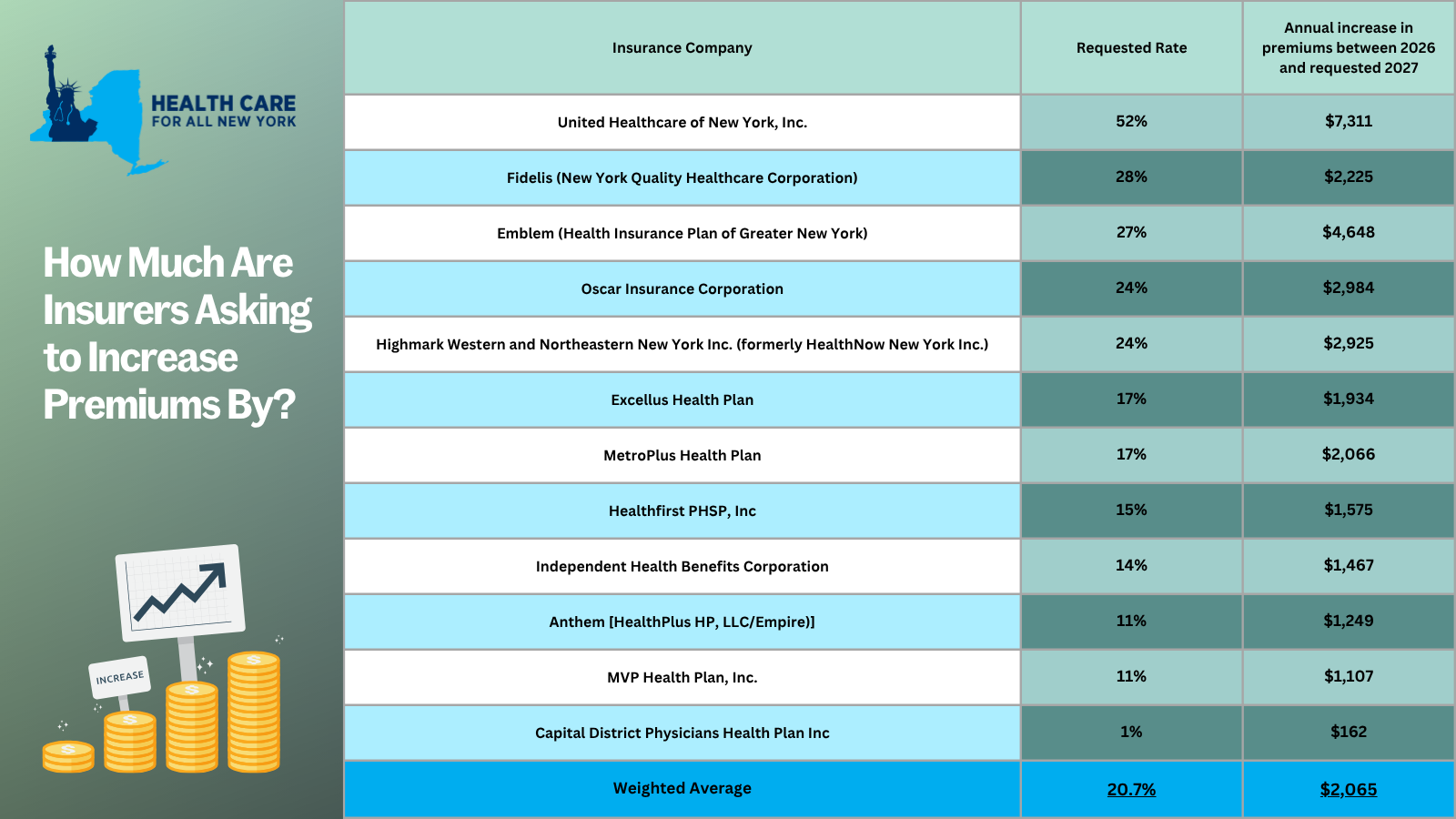
New York’s individual market carriers are seeking a weighted average premium increase of 20.7 percent, which is over five times the rate of inflation. If this year’s requests are approved, it will result in an average premium increase of 64 percent over the last five years, with four carriers’ premiums doubling in this period. In other words, if rates are approved, there will be an average premium increase of $390 per month, over the last five years.
Consumers with job-based coverage have employers, brokers, and agents who can negotiate the best premiums, scope, and coverage for their employees. By contrast, consumers in the individual market have no bargaining power over affordable premiums and out-of-pocket costs. This population depends on the Department to safeguard health insurance affordability through the annual process of rate review.
Market changes
Rate requests for the 2027 plan year coincide with two counteracting changes in the individual market:
- Expiration of enhanced advanced premium tax credits (eAPTCs)
The American Rescue Plan expired at the end of 2025, and the federal government did not extend the eAPTCs. As a result, many individuals lost federal financial assistance with health insurance premiums and exited the market. Since last year, around 46,600 enrollees have left the market.
- Return of the Essential Plan 200-250 FPL population
As a result of the State’s return to the Basic Health Program, 444,000 individuals who were previously covered through the Essential Plan lost eligibility on July 1, 2026. A portion of this population is expected to return to the individual market, likely counterbalancing the number leaving the market due to the expiration of eAPTCs.
Medical inflation (claim trend)
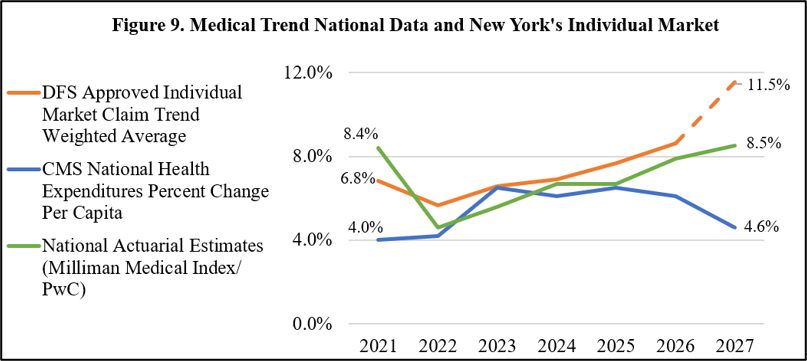
The annual claim trend is the portion of the rate request based on changes in prices and utilization of medical and pharmaceutical care. New York’s carriers submitted inconsistent annual claim trend estimates, indicating that many have not effectively controlled health care costs. The carriers’ estimates for the 2027 plan year range from 8.9 percent to 14.7 percent, with a weighted-average trend rate of 11.5 percent. This trend appears inflated and is a significant jump from the 6.7 percent approved trend over the past five years.
Additionally, this trend does not align with publicly available national estimates of claim trend. See Figure 9.
To protect patients in the 2027 plan year, HCFANY kindly asks the Department to cap each carrier’s claim trend at its respective five-year approved average. See hyperlinked letters below for more detail.
Medical expenses (Medical Loss Ratio)
Generally, premium dollars paid to carriers go toward three things: payment of medical expenses incurred by patients, administrative costs, and profit/surplus.
In New York, a minimum of 82 percent of premium dollars paid to a carrier must be used to cover payment of medical expenses (claims). This metric is referred to as a carrier’s medical loss ratio (MLR).
- An MLR exceeding 100 percent indicates that the carrier incurred more claims than could be paid by the amount they received in patient premiums.
- An MLR under 82 percent is against the law and indicates that a carrier easily covered its incurred claims and thus overcharged patients.
The MLR of five carriers in the state (MetroPlus, Emblem, Fidelis, Oscar, IHBC) fell below 82 percent in 2025. HCFANY urges the department to consider historical MLR data when approving carrier’s rate requests, and exercise caution when determining 2027 rates.
Administrative expenses
For the 2027 plan year, the carriers seek to spend, on average, 12 percent of premium dollars on administrative expenses.
HCFANY lauds the Department for capping administrative costs and preventing them from creeping up over the past six years, despite the carriers’ excessively high requests. To continue this practice, HCFANY encourages the Department to consider setting an expense ratio ceiling at or below 10 percent, in recognition of the State’s health care affordability crisis.
Profits
For the 2027 plan year, the carriers seek to retain an average of 2.1 percent of premium dollars for profit. This request is higher than the average approved profits for past years, which were around or below 1 percent.
However, reported actual profits of individual market carriers have trended upward since 2022, with the market-wide average in 2025 reaching 3.6 percent. Though driven by a few carriers (Anthem, Healthfirst, MetroPlus, MVP, Oscar), this figure is still much too high. In its 2027 comments, HCFANY kindly urges the Department to return to its practice of capping profits at 0.5 percent.
Patient voices
An integral part of the rate review process is the submission of personal comments from consumers. HCFANY thanks the Department for publishing these, exhibiting the direct impact rate increases have on patient livelihoods:
- “We are grateful this plan is available on the market, as without it we would have nothing, but currently the plan costs more than our rent. … Health insurance is not a luxury for us or anyone—last year, health insurance and the subsequent access to care meant the difference between life and death for me—but it is beginning to be priced like one.”
- “I am self-employed and pay 100% of my family’s health insurance premiums and copays out of pocket… An 11.3% increase would add more than $350 to that bill every single month, bringing our annual health insurance cost to well over $41,000. That is not a rounding error. That is a car payment. That is groceries. That is my 10-year-old son’s future.”
- “I am not someone who can simply choose to go without health insurance. I am a cancer survivor who requires ongoing medical surveillance, and my daughter also relies on this coverage. We are exactly the type of household that depends on a stable and functioning individual insurance market.”
In addition to comments about the individual market at large, HCFANY details why the Department should curb specific elements of each carrier’s request. These letters aim to protect patients from further increases in already unaffordable health care costs, and can be found below:
- Anthem
- CDPHP
- Emblem
- Excellus
- Fidelis
- Healthfirst
- Highmark
- Independent Health
- MetroPlus
- MVP
- Oscar
- United
Legislative Voices
On August 21, 2026, Senator Gustavo Rivera and Assembly Member Jessica González-Rojas, along with 70 Elected Officials, sent this letter to the Acting Superintendent of the Department of Financial Services, urging DFS to reject excessive health insurance premium increases for the 2027 Plan Year.